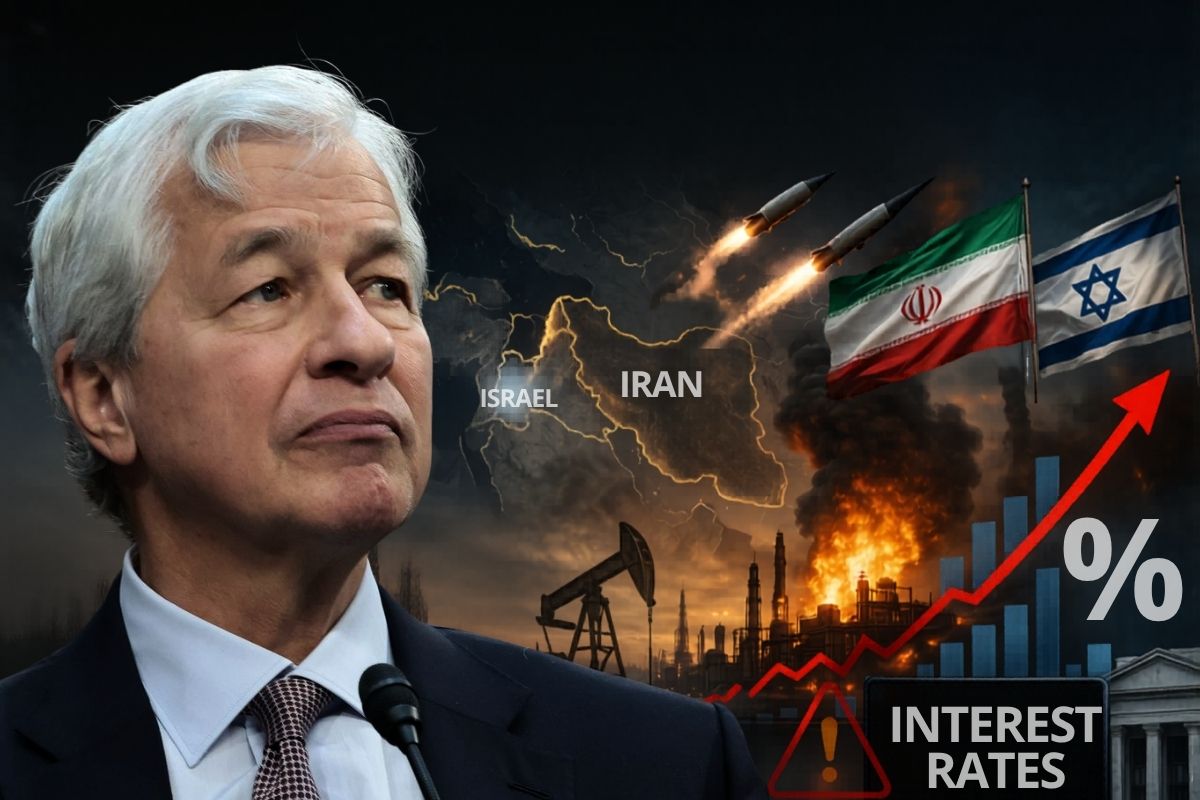
JPMorgan Chase CEO Jamie Dimon warned on Monday that the war in Iran risks oil and commodity price shocks that could keep inflation sticky and push interest rates higher than the market now expects. The alert appeared in Dimon’s annual letter to shareholders. This 48-page document is a key economic report in global finance.
Dimon runs JPMorgan Chase, the largest bank in America. It manages about $4 trillion in assets. His annual shareholder letter is a must-read for investors, policymakers, and economists everywhere.
The Skunk at the Garden Party
Dimon was clear about what he believes is the biggest overlooked risk for markets today. He warned that the scenario most likely to derail the economy would be inflation that slowly climbs rather than slowly falls — and that this alone could cause interest rates to rise and asset prices to drop. He described interest rates as being “like gravity” to almost all asset prices, adding that falling asset prices can rapidly shift market sentiment and trigger a flight to cash.
Dimon stated directly: “Now, because of the war in Iran, we additionally face the potential for significant ongoing oil and commodity price shocks, along with the reshaping of global supply chains, which may lead to stickier inflation and ultimately higher interest rates than markets currently expect.”
This is significant language from the man who runs the world’s most systemically important bank. When Dimon speaks about the direction of rates, markets listen — and act.
Why Iran? The Energy Chokepoint Nobody Can Ignore
The timing of Dimon’s letter was no coincidence. The warning came a day after U.S. President Donald Trump increased pressure on Iran. He threatened to target power plants and bridges if it doesn’t reopen the Strait of Hormuz. This waterway is crucial for global energy.
The Strait of Hormuz is a chokepoint for roughly 20% of global oil trade. Any prolonged closure or military disruption to this narrow passage between Iran and Oman would send crude prices soaring almost immediately — a supply shock with global consequences.
Dimon noted that nations heavily dependent on imported energy are already seeing the effects, and that it is not just energy — it is commodity products that are byproducts of oil and gas, like fertilizer and helium. He also noted disruptions in shipbuilding, food, and farming. These were caused by complex global supply chains.
The Broader Geopolitical Picture
Dimon’s concern extends beyond Iran alone. He cited the foremost risks facing financial markets and the economy as geopolitical in nature — including the Iran war and Russia’s war in Ukraine — both of which have an “impact on countries and economies across the globe that are not directly involved in war.”
In his 48-page letter, Dimon painted a mostly rosy picture of the U.S. economy heading into 2026. He predicted that tax cuts and deregulation from President Trump’s agenda would add $300 billion to the U.S. economy this year, boosting GDP by about 1%. He also highlighted massive spending on AI and related technologies as a productivity driver.
Yet, he was careful to temper that optimism. He noted that while the economy may be less fragile than in years past, this alone does not mean there is no “tipping point” — it just may mean it could take more straws on the camel’s back to get there.
What This Means for the Federal Reserve
High inflation over the Federal Reserve’s 2% target might lead the central bank to increase interest rates. This could help slow down rising prices. This is the key transmission mechanism that Dimon is warning about — a geopolitical shock becoming a monetary policy problem.
The Fed has spent the last two years trying to lower inflation without causing a recession. A spike in oil prices from the Iran conflict could reverse that progress. This might force the Fed to raise rates when many investors expected cuts.
Dimon warned shareholders in his annual letter that the “resilient” U.S. economy could face rising inflation pressures again. This could happen if the war in Iran disrupts global energy markets.
Historical Parallels: 1974 and 1982
Dimon mentioned the oil-triggered recessions of 1974 and 1982. He used these examples to show how the conflict with Iran might affect borrowing costs. Energy shocks from the Middle East led to economic downturns and higher interest rates in the United States every time.
The 1973-74 Arab oil embargo caused U.S. inflation to peak above 12%. The 1979-80 Iranian Revolution led to more oil shocks. As a result, U.S. interest rates soared to nearly 20% by 1981. These are not distant historical footnotes — they are Dimon’s cautionary reference points for what is possible.
Other Risks Dimon Flagged
Beyond the Iran conflict, Dimon sounded alarms on several other fronts:
- Private Credit Markets: Dimon said the $1.8-trillion private credit market is relatively small but warned that once the credit cycle weakens, losses on all leveraged lending will be higher than expected. He also highlighted that private credit lacks transparency and rigorous valuation of loan “marks,” increasing the chance that investors will sell if they think the environment will worsen.
- Bank Capital Rules: Dimon sharply criticised the new capital rules from U.S. regulators. He called some parts “nonsensical.” He described JPMorgan’s GSIB surcharge as “absurd” and “un-American.”
- AI & Technology: Dimon disagreed with comparisons to past tech manias. He believes that money spent on AI can truly transform things, not just speculate. Still, he noted that big tech changes often lead to wider societal disruptions.
The Bottom Line
Dimon’s message is clear: the biggest wildcard for interest rates in 2026 is not the Fed’s data models or domestic inflation readings — it is a military conflict thousands of miles away. If the Iran war escalates and disrupts global energy supplies, borrowers, investors, and ordinary consumers could feel the effects through higher mortgage rates, more expensive credit, and a shakier stock market.
For anyone watching their savings, planning a home purchase, or managing a business, the warning from JPMorgan’s top executive is worth taking seriously.